Singapore Establishes National Alliance to Advance Tropical Weather and Climate Research

Singapore has launched a national research platform to strengthen tropical weather and climate science capabilities and support more accurate forecasting across Southeast Asia. The Climate and Weather Research Alliance Singapore (CAWRAS) brings together government agencies and leading universities to coordinate research, develop advanced modelling tools and build specialist expertise. The initiative will implement a S$25 million Weather Science Research Programme (WSRP) under the Research, Innovation and Enterprise 2025 (RIE2025) plan, supporting projects that apply high‑resolution modelling, artificial intelligence and enhanced observational data to improve weather prediction.
Announced by the National Environment Agency and research partners, the alliance will coordinate national capabilities in weather science while strengthening collaboration between public research institutions. Details of the initiative were outlined in the official announcement on the A*STAR website. Over time, the alliance is expected to broaden its focus to include longer‑term climate research relevant to Southeast Asia.
National Research Alliance for Tropical Weather Science
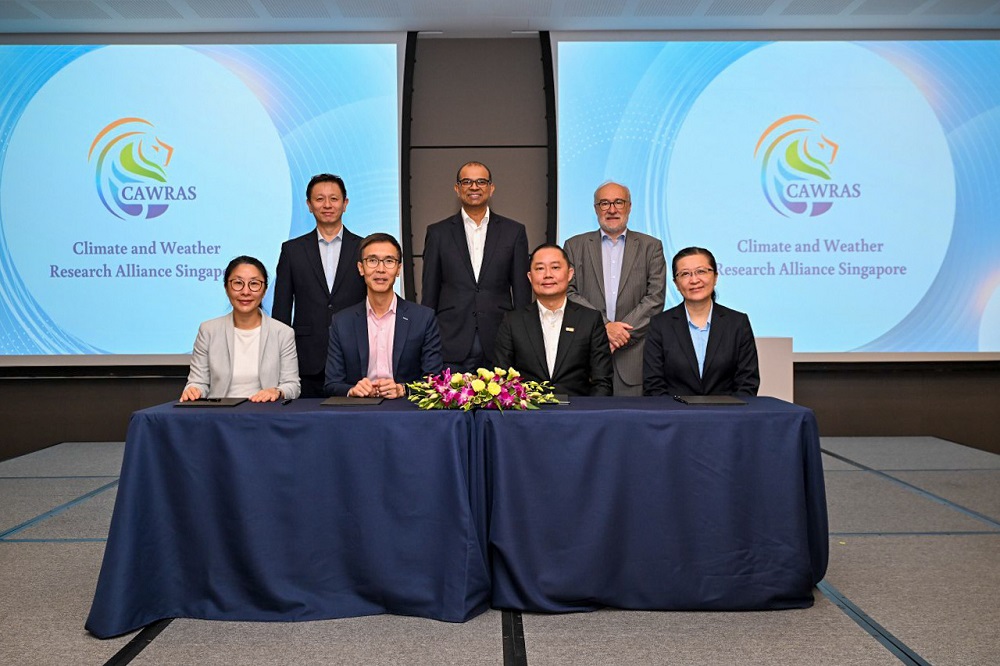
CAWRAS is jointly established by the National Environment Agency (NEA), the Agency for Science, Technology and Research (A*STAR), Nanyang Technological University (NTU Singapore) and the National University of Singapore (NUS). The alliance is led by the Centre for Climate Research Singapore (CCRS), the research arm of the Meteorological Service Singapore.
The initiative reflects growing demand for more precise forecasting in dense tropical cities where local terrain, urban infrastructure and ocean‑atmosphere interactions create complex weather patterns. Advances in high‑performance computing, high‑resolution modelling and artificial intelligence are enabling researchers to analyse these dynamics in greater detail.
“CAWRAS is a strong commitment by our research institutions, working with the Centre for Climate Research Singapore, to collectively tackle the unique challenges of predicting weather in our tropical urban environment and enhance our understanding of climate change. We look forward to translating science to improved services to bolster Singapore’s resilience in the face of climate change.” — Koh Li-Na, Director-General of the Meteorological Service Singapore, NEA
Weather Science Research Programme Projects
Ten projects have been funded under the Weather Science Research Programme, covering four broad areas: improving the use of weather observations, developing next‑generation weather and climate models, conducting historical weather reanalysis for Southeast Asia and enhancing forecasting accuracy through advanced post‑processing techniques.
Several projects focus on improving predictions of hazardous weather events in the tropical maritime region. Researchers are exploring how artificial intelligence can enhance the detection of convective hazards such as heavy rainfall, lightning and strong winds. These techniques are designed to complement traditional physical weather models by identifying complex patterns within large datasets.
Another project will develop a high‑resolution urban weather prediction system capable of representing the complex interactions between Singapore’s dense built environment and atmospheric conditions. By modelling the effects of buildings and urban structures on wind, temperature and rainfall patterns, researchers aim to improve forecasts of extreme events such as intense rainfall and heat stress.
The programme will also produce a regional historical weather reanalysis dataset covering the period from the 1990s to 2025. By integrating historical observations with advanced numerical weather prediction models, researchers aim to generate a comprehensive climate record for Singapore and the wider Maritime Continent. Such datasets can support planning and operational decision‑making across sectors including aviation, maritime operations, energy and urban planning.
Testbed and Supercomputing Support for Advanced Modelling
The projects will be supported by a new Climate and Weather Research and Evaluation Testbed (CAWRET), which will provide access to extensive observational datasets, modelling tools and supercomputing resources. Hosted by A*STAR, the platform will work closely with the National Supercomputing Centre Singapore to meet the computational requirements of high‑resolution climate modelling.
“A*STAR is proud to contribute to this national effort to improve Singapore’s weather research. Our expertise in high performance computing, artificial intelligence (AI), modelling and simulation will contribute to the development of the Climate and Weather Research & Evaluation Testbed (CAWRET) and support regional analysis. We look forward to working closely with our partners to translate scientific innovations into practical solutions that strengthen Singapore’s resilience to weather-related challenges, particularly in sectors in aviation, maritime, and urban planning.” — Lim Keng Hui, Assistant Chief Executive (Science & Engineering Research Council), A*STAR
Universities Contribute Interdisciplinary Climate Research
Singapore’s universities will play a central role in the alliance, contributing expertise across atmospheric science, artificial intelligence, urban climate modelling and environmental engineering. Researchers from NUS will apply capabilities in hydroclimatology, AI and urban climate analysis, building on initiatives highlighted in NUS’s interdisciplinary smart research programmes.
“Leveraging NTU’s established track record in Earth and environmental sciences, supported by infrastructure like the Earth Observatory of Singapore, and our pioneering Climate Transformation Programme, we are uniquely positioned to combine AI, remote sensing, and advanced environmental modelling to forecast tropical weather with enhanced accuracy. Through interdisciplinary collaboration spanning fields like medicine, public health, environmental engineering, and urban resilience, NTU will contribute to Singapore’s role as a leading hub for tropical weather and climate science research in Southeast Asia.” — Ernst Kuipers, Vice President (Research), NTU Singapore
“NUS welcomes this national research alliance as an integral part of our commitment to research and innovation in the areas of sustainability and climate change. Leveraging our research strengths such as urban climate modelling, hydroclimatology, artificial intelligence, and foundation modelling, we are excited to contribute significantly on a national level to Singapore’s weather prediction capabilities while nurturing the next generation of weather and climate scientists.” — Liu Bin, Deputy President (Research and Technology), NUS
The alliance also highlights the growing role of artificial intelligence and advanced analytics in scientific research. Building the necessary skills base for such technologies has become an important national priority, reflected in wider initiatives aimed at strengthening workforce resilience in the AI era.
By bringing together research institutions, advanced computing resources and interdisciplinary expertise, CAWRAS aims to strengthen Singapore’s capacity to study and forecast tropical weather systems while supporting evidence‑based planning and climate resilience across the region.