Sagarmala Programme Expands India’s Maritime Capacity And Port Connectivity

India’s Sagarmala programme is reshaping the country’s maritime sector through port modernisation, improved connectivity and coastal economic development. Launched in March 2015, the initiative aims to strengthen logistics efficiency and reduce transport costs by expanding port capacity and encouraging the use of coastal shipping and inland waterways. According to a government release, 845 projects worth approximately ₹6.06 lakh crore have been identified under the programme, with hundreds already completed or underway.
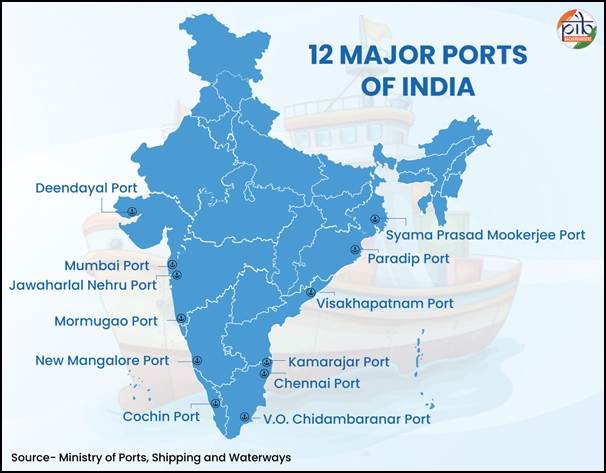
India’s maritime network plays a central role in trade. The country has around 11,099 kilometres of coastline and roughly 14,500 kilometres of potentially navigable inland waterways. About 95% of India’s trade by volume and nearly 70% by value moves through maritime routes. Major ports overseen by the Ministry of Ports, Shipping and Waterways form the backbone of this system, handling commodities ranging from crude oil and coal to containers, fertilisers and agricultural goods.
Five-Pillar Strategy For Port-Led Development
The Sagarmala programme focuses on port-led development through a framework built around five pillars and 24 project categories. The approach combines infrastructure investment with industrial and community development in coastal regions.
The first pillar centres on modernising existing ports and developing new ones to increase cargo capacity and operational efficiency. Upgrades include mechanisation, digital systems and expanded infrastructure to handle growing maritime trade.
A second priority is improving connectivity between ports and their hinterlands. Multimodal transport systems integrate road, rail, coastal shipping and inland waterways, enabling faster and more cost‑effective cargo movement. Similar efforts to improve data-driven logistics planning can be seen in initiatives such as India’s work through the National Industrial Corridor Development Corporation to strengthen smart logistics and trade infrastructure.
Additional pillars promote port-led industrialisation through coastal economic clusters, strengthen coastal community livelihoods and expand the use of coastal shipping and inland waterways as alternatives to road and rail transport.
Project Pipeline And Infrastructure Expansion
As of 24 March 2026, 315 projects valued at approximately ₹1.57 lakh crore have been completed under Sagarmala, while 210 projects are currently under implementation and 320 remain in the planning stage. The overall project pipeline reflects a long-term effort to expand maritime infrastructure and improve logistics efficiency.
Several targeted investments have strengthened coastal infrastructure and cargo capacity. Eleven fishing harbour projects worth ₹1,057 crore have been completed, benefiting more than 30,000 fishers. In Karnataka, the third phase of the Malpe fishing harbour expansion has been completed, while development of a harbour at Kulai is ongoing.
Seven coastal berth projects costing ₹494 crore have also been completed, adding 9.84 million tonnes per annum (MTPA) of cargo handling capacity. Other projects include the ongoing renovation of the historic bascule bridge at Syama Prasad Mookerjee Port in Kolkata and safety upgrades at Mumbai Port’s Pir Pau terminal.
Improved Port Performance And Maritime Logistics
Operational indicators suggest improvements in the performance of India’s port system. In the 2025–26 financial year, major ports handled a record 915.17 million tonnes of cargo, surpassing the annual target of 904 million tonnes and marking year‑on‑year growth of 7.06%.
Efficiency has also improved. Average vessel turnaround time at major ports has declined from 96 hours in 2014 to about 49.5 hours in 2025. Nine Indian ports now appear in the global top 100 rankings, with Visakhapatnam Port included among the top 20 for container traffic.
Inland waterways are also carrying a growing share of cargo. Freight transported through these routes increased from 18.10 MTPA in FY2013–14 to 145.50 MTPA in FY2024–25, reflecting a significant expansion of alternative transport corridors.
Passenger Ferry Networks And Urban Water Transport
Sagarmala has also supported passenger mobility through coastal and inland ferry systems. A total of 29 roll-on/roll-off passenger (Ro‑Pax) and ferry projects were launched with an investment of ₹1,233 crore. Seventeen of these projects, worth ₹706 crore, have already been completed.
Services such as the Ghogha–Hazira Ro‑Pax route have significantly reduced travel time, cutting a road journey of around 10 hours to roughly four hours by sea. Similarly, the Mumbai–Mandwa ferry route replaces a 109‑kilometre road trip with an 18.5‑kilometre sea crossing, helping ease congestion and shorten commuting times.
Skills Development And Coastal Livelihoods
Beyond infrastructure, the programme also focuses on employment and community development in coastal areas. Through convergence with the Deen Dayal Upadhyaya Grameen Kaushalya Yojana (DDU‑GKY), more than 7,600 candidates have received skills training, with over 3,100 placed in maritime and related sectors.
Overall, Sagarmala is estimated to create around 10 million job opportunities, including 4 million direct and 6 million indirect roles linked to port-led industrialisation and maritime infrastructure expansion. Broader national investments in digital infrastructure and connectivity—such as initiatives supporting next-generation connectivity across 4G, 5G and satellite networks—are expected to complement these logistics improvements.
Sagarmala 2.0 And Long-Term Maritime Strategy
The next phase, Sagarmala 2.0, is intended to build on progress made since 2015 and align with broader national strategies including Maritime India Vision 2030 and the Maritime Amrit Kaal Vision 2047. The initiative aims to further modernise ports, strengthen hinterland connectivity and expand inland waterways and coastal shipping services.
The proposed programme includes budgetary support of ₹85,482 crore and aims to catalyse approximately ₹3.6 lakh crore in total investment across port infrastructure, maritime services, coastal development, research and institutional strengthening.
Over the past decade, the Sagarmala programme has contributed to expanding capacity, improving operational efficiency and strengthening logistics networks across India’s maritime sector. As the next phase develops, policymakers will focus on integrating infrastructure investment, industrial development and community outcomes to support long-term trade and economic growth.