
Maharashtra has formally joined the reform-based implementation framework of Jal Jeevan Mission 2.0 after signing a memorandum of understanding with the Union government. The agreement aims to strengthen rural drinking water services by improving service quality, accountability and long-term sustainability. Approved by the Union Cabinet on 10 March 2026, the revised mission framework places greater emphasis on community participation, digital monitoring and institutional reforms to ensure reliable household tap water supply across rural areas.
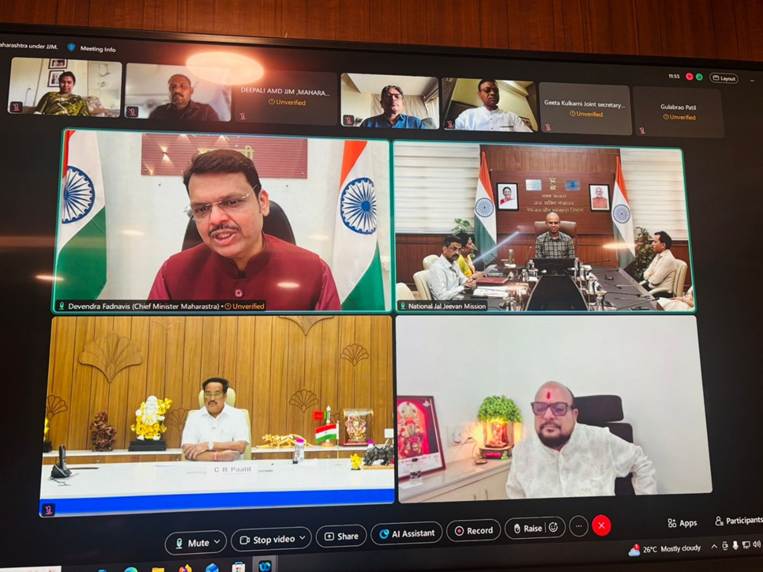
The memorandum was signed on 19 March 2026 in the presence of Union Minister for Jal Shakti C R Patil and Maharashtra Chief Minister Devendra Fadnavis, with senior officials from both governments participating via video conference. According to the official release, Maharashtra’s inclusion brings the state within a national reform-oriented approach focused on outcomes rather than infrastructure delivery alone.
Focus on service delivery and accountability
Addressing the event, the Union Minister for Jal Shakti said the mission has already enabled tap water connections for around 80 per cent of rural households nationwide. Under Jal Jeevan Mission 2.0, the focus shifts towards assured service delivery, structural reforms and sustained performance, alongside a stated zero-tolerance approach to corruption and irregularities.
Referring to research findings cited by the ministry, the mission is estimated to have reduced the daily burden of water collection for nearly nine crore women. Improved access to safe drinking water is also associated with substantial public health gains, reinforcing the mission’s broader social and economic objectives.
Community feedback and digital transparency
A key element of the reform-based agreement is the introduction of a Jal Seva Assessment at the gram panchayat level. Community feedback on the quality, regularity and reliability of rural drinking water services will be collected and made visible to citizens through the ‘Meri Panchayat’ application, strengthening transparency and local accountability.
This approach aligns with wider national efforts to apply digital tools and data-driven planning in the water sector, as seen in initiatives where digital innovation and GIS are being used to support water management. By linking citizen feedback with service outcomes, the mission seeks to ensure that infrastructure translates into consistent, usable supply.
Institutionalising public participation through Jal Utsav
To further embed public participation, the memorandum provides for an annual, three-tier Jal Utsav campaign. This includes a national-level water festival, state-level river or water celebrations, and local events at the gram panchayat level that integrate water awareness with cultural traditions.
The National Water Festival 2026 commenced on 8 March 2026 with a nationwide ‘Jal Arpan’ initiative and is scheduled to conclude on World Water Day, 22 March 2026. A national event held on 11 March 2026 was attended by President Droupadi Murmu, underlining the significance attached to community-led water stewardship.
Strengthening local ownership and planning capacity
Under the agreement, all completed piped water supply schemes will be formally handed over to gram panchayats, village water and sanitation committees and local communities through a structured ‘Jal Arpan’ process. This is intended to reinforce local ownership, operational responsibility and long-term sustainability of rural water systems.
The framework also mandates the use of a decision support system developed by the Department of Drinking Water and Sanitation at district and gram panchayat levels. Integrated with national water datasets, the platform is designed to support source sustainability planning and evidence-based decision-making, complementing broader digital government initiatives across sectors.
Maharashtra’s implementation roadmap
Chief Minister Devendra Fadnavis reaffirmed the state’s commitment to providing sustainable, reliable and quality drinking water to every rural household. With revised administrative approvals, Maharashtra plans to place greater emphasis on construction quality, timely execution and learning from earlier phases of the mission.
With enhanced financial provisions and an extended timeline until December 2028, Jal Jeevan Mission 2.0 aims to establish a resilient, community-centred national model for rural drinking water services. The reforms are positioned to contribute to long-term water security and improved living standards in line with the national vision of Viksit Bharat @2047.