India’s Budget 2026–27 Strengthens Special Economic Zones to Boost Exports and Investment

India’s Union Budget 2026–27 introduces targeted measures to strengthen Special Economic Zones (SEZs), aiming to improve export competitiveness, support manufacturing and attract global investment. A key proposal allows eligible SEZ manufacturing units to sell a limited share of their output in the domestic tariff area at concessional duty rates. According to a government release, the reforms are designed to improve capacity utilisation while maintaining the export-oriented character of SEZs and reinforcing their role in India’s trade and investment ecosystem.
The budget also extends tax incentives for cloud and data-centre operations within SEZs, signalling a broader effort to attract technology investment alongside manufacturing. These initiatives complement wider fiscal measures discussed in India’s budget strategy to support AI, semiconductors and IT growth, which aim to strengthen the country’s position in advanced technology supply chains.
SEZs as pillars of India’s export-led growth strategy
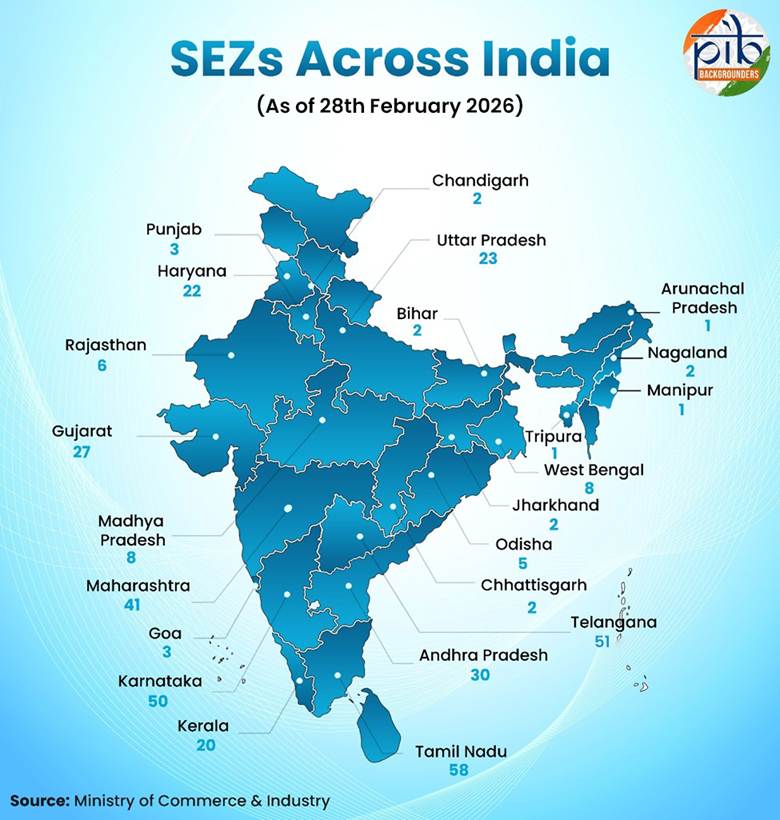
Special Economic Zones are designated areas operating under a distinct regulatory and fiscal framework designed to encourage trade and investment. These zones function as duty-free enclaves for authorised operations and are treated as territories outside India’s customs jurisdiction for specific purposes.
SEZ units can manufacture goods, provide services and operate free trade warehousing facilities. Since the introduction of the Special Economic Zones Act 2005, these zones have played a central role in expanding exports, supporting industrial growth and generating employment across multiple sectors.
As of 28 February 2026, India had 368 notified SEZs. The zones collectively contribute to foreign exchange earnings, infrastructure development and the emergence of local business ecosystems.
Budget reform allows limited domestic sales at concessional duty
The budget proposes a one-time measure allowing eligible SEZ manufacturing units to sell a defined share of their production into the Domestic Tariff Area (DTA) at concessional customs duty rates instead of standard import duties. The permitted volume will be capped as a proportion of the unit’s export performance.
Under Section 30 of the SEZ Act 2005, goods and services supplied from SEZs to the DTA are treated as imports and normally attract applicable duties and taxes. The new measure seeks to provide temporary flexibility while ensuring that domestic manufacturers operating outside SEZs continue to compete on a level playing field.
Officials expect the change to help manufacturers improve capacity utilisation and reduce export costs without diluting the export-oriented nature of SEZ operations.
Export growth and investment trends in India’s SEZ network
Recent data indicates strong growth across India’s SEZ ecosystem. By December 2025, employment across the zones exceeded 3.17 million people, while cumulative investment reached approximately ₹7.86 lakh crore.
Exports from operational SEZs surpassed ₹11.70 lakh crore during the 2025–26 financial year up to December 2025. This represents a 32.02% increase compared with the same period in 2024–25, underscoring the continued importance of the zones as export engines.
Policy evolution supporting high‑technology manufacturing
India was among the first Asian economies to adopt the export processing zone model, establishing Asia’s first such zone in Kandla in 1965. The SEZ policy announced in April 2000 later sought to address regulatory constraints and attract greater foreign investment through improved infrastructure and simplified procedures.
The SEZ Act 2005 and SEZ Rules 2006 created a more stable regulatory framework, including single-window approvals for central and state clearances. Development Commissioners oversee compliance and performance monitoring through regular reporting mechanisms.
Further amendments in June 2025 simplified requirements for establishing SEZs focused on semiconductor and electronic component manufacturing. New zones were subsequently notified in Sanand, Gujarat and Dharwad, Karnataka to support these sectors. These developments align with broader initiatives promoting advanced manufacturing and electronics self-reliance, including programmes highlighted in India’s push for smart manufacturing in electronics.
The semiconductor sector typically requires substantial capital investment and longer development timelines before achieving profitability. Adjustments to SEZ rules therefore include relaxed land requirements and provisions enabling domestic supply of semiconductor products from SEZ units.
Incentives designed to attract global investors
SEZs continue to offer a range of incentives intended to attract both domestic and foreign investors. These measures aim to support export-oriented production while improving ease of doing business within designated zones.
- Duty-free imports and procurement: Goods required for development, operation and maintenance of SEZ units can be imported or sourced domestically without customs duties.
- Tax treatment: Supplies to SEZs are zero-rated under the Integrated Goods and Services Tax (IGST) framework.
- Streamlined approvals: Single-window clearance mechanisms are available for central and state government permissions.
Strategic role of SEZs in India’s future economic growth
From port-linked zones such as Mundra and Kandla to sector-focused ecosystems including Sri City and GIFT City, SEZs form a significant part of India’s industrial and trade infrastructure. They provide integrated logistics, modern facilities and access to domestic and international markets.
With policy adjustments aimed at strengthening exports, expanding advanced manufacturing and encouraging technology investment, the SEZ framework is expected to remain an important mechanism for integrating India more deeply into global value chains.