India Releases Jal Jeevan Mission 2.0 Guidelines at Jal Mahotsav 2026

India’s Ministry of Jal Shakti has released the operational guidelines for Jal Jeevan Mission (JJM) 2.0, marking a shift from infrastructure expansion to long-term service delivery and sustainability in rural drinking water. The guidelines were issued digitally at the conclusion of Jal Mahotsav 2026, a 15-day nationwide campaign aligned with World Water Day. The programme’s extension to December 2028 underscores renewed emphasis on accountability, community ownership and reliable services for rural households.
The announcement was made during the closing ceremony of Jal Mahotsav 2026, held from 8 March to 22 March, and the fifth Sujal Gram Samvad. The event, hosted by the Department of Drinking Water and Sanitation, was attended virtually by Union Minister for Jal Shakti C R Patil and Minister of State V Somanna. The original release was issued by the Press Information Bureau and is available on the official government source.
Jal Jeevan Mission 2.0: From Infrastructure to Service Delivery
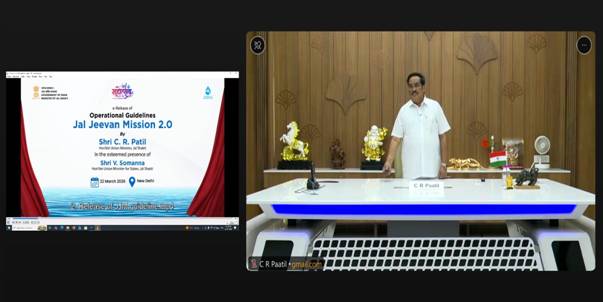
Following Cabinet approval, JJM 2.0 extends the national rural drinking water programme to December 2028. While the first phase prioritised rapid infrastructure rollout, the revised framework places greater weight on service standards, system functionality and governance reforms. The objective is to ensure that rural families receive regular, adequate and safe drinking water on a sustainable basis.
The guidelines reflect lessons from on-ground implementation and call for a decisive move towards a service delivery-oriented model. This includes clearer institutional roles across state, district and village levels, alongside strengthened monitoring and performance benchmarks. The approach aligns with wider public-sector efforts to apply digital and data-led methods to water governance, as seen in digital innovation and GIS-enabled water management initiatives.
Structural Reforms and State-Level Commitments
A central feature of JJM 2.0 is the introduction of reform-linked memoranda of understanding between the Union government and states. These agreements are intended to anchor accountability and ensure that structural reforms translate into measurable improvements in service delivery. During Jal Mahotsav 2026, nine states signed such memoranda, signalling their commitment to sustainable rural water services.
The guidelines stress that reliable water services depend on source sustainability. They call for coordinated action on water conservation, rainwater harvesting, greywater management and aquifer recharge. This systems-based perspective mirrors broader applications of analytics and spatial tools in the sector, including AI and GIS-based visualisation for water infrastructure safety.
Jal Mahotsav 2026 and Community Participation
Jal Mahotsav 2026 was observed as a nationwide campaign from International Women’s Day to World Water Day, with activities spanning village meetings, awareness drives, school engagement and the handover of drinking water assets to gram panchayats. The initiative was designed to advance the principle of “Jal Sanchay se Jan Bhagidari”, positioning water conservation and management as a people-led movement rather than a purely administrative exercise.
Throughout the campaign, communities undertook water source cleaning, pond rejuvenation and water quality testing using field test kits. These activities were intended to build local capacity and reinforce community ownership of drinking water systems, a core pillar of the JJM 2.0 framework.
Sujal Gram Samvad: Village Experiences Informing Policy
The fifth Sujal Gram Samvad formed a key component of the closing programme, bringing village-level experiences to a national मंच. Representatives from five gram panchayats across Uttarakhand, Haryana, Chhattisgarh, Odisha and Madhya Pradesh shared practical insights into managing rural drinking water services under Jal Jeevan Mission.
Across the dialogues, common themes emerged: locally managed operations and maintenance, regular water quality testing, modest user charges to fund upkeep, and rapid response to system faults. Several villages highlighted the role of women and community institutions in sustaining services, as well as improvements in health, sanitation and school attendance following reliable tap water supply.
Key Reform Areas Highlighted in JJM 2.0
The operational guidelines outline a clear reform agenda to strengthen rural drinking water governance. These focus on service outcomes rather than asset creation alone and are intended to support long-term reliability.
- Assured service delivery: Defined performance standards to ensure regular and adequate water supply.
- Clear accountability: Well-defined responsibilities at state, district and gram panchayat levels.
- Source sustainability: Integrated water conservation, source protection and community stewardship.
As Jal Mahotsav 2026 concluded on World Water Day, the ministry called on all stakeholders to carry forward the momentum of community participation. The implementation of JJM 2.0 is positioned as a critical step towards making every village a Sujal Gram, supporting the broader goal of universal access to safe drinking water and India’s long-term development vision.