India Advances Naval Research With Large Cavitation Tunnel Facility In Visakhapatnam

India has begun construction of a Large Cavitation Tunnel (LCT) facility at the Naval Science and Technological Laboratory (NSTL) in Visakhapatnam, a move intended to strengthen the country’s naval research and testing capabilities. Defence Minister Rajnath Singh laid the foundation stone for the project on 3 April 2026. According to the official government announcement, the facility is expected to support the indigenous design, development and validation of advanced naval platforms and propulsion systems, reducing reliance on overseas testing infrastructure.
Infrastructure to Support Indigenous Naval Technology
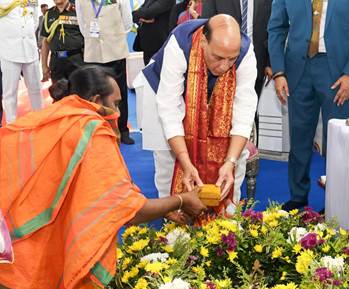
The Large Cavitation Tunnel is being developed at the Defence Research and Development Organisation’s (DRDO) Naval Science and Technological Laboratory, one of India’s key centres for underwater weapons and naval systems research. The new facility will enable scientists and engineers to conduct hydrodynamic testing of ship and submarine designs within the country.
Rajnath Singh said that, until now, some advanced tests had to be conducted overseas even after systems were successfully designed domestically. The new infrastructure aims to change that by providing the capability to design, develop and validate equipment, systems and subsystems using domestic resources.
“Now this situation will change. This facility is not just an infrastructure project, but an enabling system that will strengthen our capabilities in advancing propulsion systems, enable efforts focused on noise reduction and further reinforce our stealth capabilities.” — Rajnath Singh, Defence Minister, Government of India
Supporting Ship Design, Stealth and Propulsion Research
The Large Cavitation Tunnel will support hydrodynamic research needed to design next-generation ships, submarines and underwater platforms. Cavitation testing is essential in naval engineering as it helps engineers understand how propellers and hull designs behave under different pressure and flow conditions, which affects propulsion efficiency, vibration and acoustic signatures.
By improving testing capabilities, the facility is expected to help reduce underwater noise and enhance stealth characteristics in naval vessels. Once operational, it will enable more precise validation of propulsion systems and hydrodynamic designs for major platforms such as destroyers and aircraft carriers.
A Strategic Research Asset for India’s Naval Ecosystem
The government describes the project as a strategic national asset intended to strengthen India’s indigenous hydrodynamic research capability. The facility is being executed in turnkey mode with international technical collaboration, combining global expertise with domestic engineering capabilities.
Its design will allow both closed-loop simulations used in submarine studies and free-surface simulations required for surface ship research within a single integrated system. This combination is expected to provide comprehensive experimental capabilities for naval hydrodynamics.
Broader Context of India’s Defence and Technology Development
The initiative aligns with the government’s broader push for technological self-reliance under the Atmanirbhar Bharat policy framework. Investments in research infrastructure and innovation ecosystems have also been visible in civilian technology domains, including initiatives aimed at building a national artificial intelligence ecosystem and collaborative research programmes such as the next-generation telecom research hub led by C-DOT and IIT-Roorkee.
During his visit to NSTL, the Defence Minister also reviewed demonstrations of advanced underwater systems, including torpedoes, naval mines, decoys and autonomous underwater vehicles (AUVs). A live demonstration of man-portable AUV swarms highlighted emerging capabilities in autonomous maritime operations and future naval warfare technologies.
He also inspected technology spin-offs developed by the Naval Systems Materials Cluster laboratories following Operation Sindoor. These included innovations in swarm technologies and lithium-ion battery development, both considered important for next-generation defence systems and operational readiness.
Senior defence officials attending the event included Chief of Defence Staff General Anil Chauhan, Chief of the Naval Staff Admiral Dinesh K Tripathi and Vice Admiral Sanjay Bhalla, Flag Officer Commanding-in-Chief of the Eastern Naval Command.