Bharat Vidyut Summit 2026 Opens With Focus on Grid Expansion and Clean Energy Integration

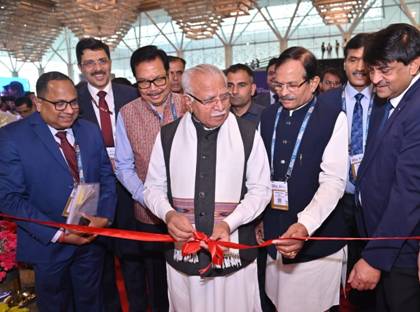
The first edition of the four-day Bharat Vidyut Summit 2026 has opened in New Delhi, bringing together policymakers, utilities and industry to examine India’s power sector transition. Inaugurated at Yashobhoomi by the Union Minister for Power and for Housing and Urban Affairs, Manohar Lal, the summit set out the government’s priorities on transmission expansion, clean energy integration and long-term system reliability, alongside the release of two strategic planning reports by the Ministry of Power.
The event was announced by the Ministry of Power through an official government press release and attended by senior ministers and officials, including the Minister for New and Renewable Energy and for Consumer Affairs, Food and Public Distribution, Pralhad Joshi, and senior representatives from the Central Electricity Authority.
Strategic plans for meeting future electricity demand
During the opening session, the Ministry of Power released the National Resource Adequacy Plan, which outlines how India intends to meet rising electricity demand through a balanced energy mix. A second report detailed a transmission development plan to support the integration of more than 900 gigawatts of non-fossil fuel generation capacity by 2035–36.
The transmission plan envisages the development of 137,500 circuit kilometres of new transmission lines and substations with a combined capacity of 827,600 megawatts. The estimated investment is ₹7.93 lakh crore, aimed at strengthening grid resilience and enabling large-scale renewable energy evacuation.
Progress in capacity growth and grid resilience
In his address, Manohar Lal highlighted the expansion of India’s transmission infrastructure, which has grown by 72% to exceed 500,000 circuit kilometres. He noted that the country successfully met peak electricity demand of 250 gigawatts in 2024–25 and is preparing to manage demand of 270 gigawatts and above in the coming years.
“आज का दिन महज़ एक और दिन नहीं है, बल्कि भारत के ऊर्जा परिवर्तन के लिए संकल्प का दिन है।” — Manohar Lal, Union Minister for Power, Government of India
The minister also pointed to opportunities for investment in the power sector over the next two decades, while referencing initiatives such as cross-border energy connectivity and proposals for undersea transmission networks as part of a longer-term vision towards 2047.
Role of renewables and system balancing
Pralhad Joshi emphasised that while thermal power would continue to underpin system stability, renewable energy represents the only sustainable long-term pathway. He underlined the need for a carefully managed transition that balances scale, speed and skills across the sector.
Minister of State for Power and New and Renewable Energy Shripad Naik said India’s installed power capacity has more than doubled since 2014, driven by rapid growth in renewables. Solar capacity alone has expanded from 2.8 gigawatts to more than 143 gigawatts, with millions of households and farmers now participating in decentralised clean energy generation.
Digital infrastructure and future readiness
Power Secretary Pankaj Agarwal described India as operating one of the world’s largest synchronised electricity grids, supported by advanced balancing systems, widespread smart meter deployment and a clearer policy framework. These developments align with broader government efforts to strengthen digital public infrastructure, including work on data-driven systems discussed in analysis of India’s national AI ecosystem.
The focus on smart infrastructure and system intelligence also reflects wider fiscal and policy priorities highlighted in assessments of India’s budget support for digital and technology-led growth, which are increasingly relevant to energy system planning and operations.
A global platform for power sector collaboration
Organised by the Ministry of Power with industry participation, Bharat Vidyut Summit 2026 features more than 100 conference sessions, over 300 speakers and representation from more than 80 countries. The programme includes participation from over 500 exhibitors, including more than 100 start-ups, and is expected to attract over 25,000 visitors.
The scale of the summit reflects India’s intent to position its power sector as reliable, investment-ready and increasingly integrated with global energy and technology developments, including responsible approaches to digitalisation such as those outlined in discussions on inclusive and accountable AI adoption.