India’s Sadhana Saptah 2026 Focuses on Capacity Building for Citizen-Centred Governance

India has launched Sadhana Saptah 2026, a nationwide initiative aimed at strengthening civil service capabilities to support more responsive and citizen‑centred governance. Held from 2 to 8 April 2026, the programme brings together more than 100 central ministries and departments, 36 states and union territories, and over 250 training institutions. According to the official government release, the week‑long effort focuses on technology adoption, institutional learning, and measurable public outcomes as part of the broader Mission Karmayogi civil service reform agenda.
The initiative is organised by the Department of Personnel and Training, the Capacity Building Commission, and Karmayogi Bharat. It marks both the foundation anniversary of the Capacity Building Commission and five years since the launch of Mission Karmayogi, a central government programme designed to modernise the skills, attitudes and competencies of India’s public workforce.
Mission Karmayogi and Civil Service Reform
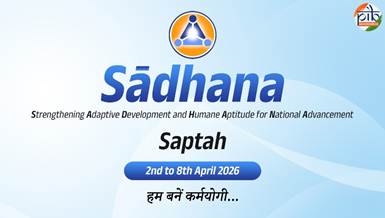
Sadhana Saptah operates within the framework of Mission Karmayogi, formally known as the National Programme for Civil Services Capacity Building. The programme seeks to move India’s civil service training model from a rule‑based approach towards a role‑based and competency‑driven system, aligning training with the responsibilities officials carry in their roles.
Two institutions support this reform agenda. The Capacity Building Commission, established in 2021, assists ministries and departments in designing and implementing capacity development plans. Karmayogi Bharat, created in 2022 as a special purpose vehicle, manages the digital learning ecosystem for civil servants.
Central to this ecosystem is the iGOT Karmayogi digital learning platform. The platform provides online training in behavioural, functional and domain‑specific competencies, enabling public officials to access learning resources from any location. Similar efforts to strengthen workforce capabilities have also been highlighted in initiatives aimed at building skills and infrastructure for a future‑ready workforce.
Digital Learning and Capacity Development at Scale
Over the past five years, the Mission Karmayogi ecosystem has expanded significantly. More than 15 million learners have registered on the iGOT platform, completing over 80 million courses across more than 4,600 programmes offered in multiple languages. More than 130 structured capacity development plans have also been created across government organisations.
Learning outcomes are increasingly integrated into performance management systems, reflecting a broader shift in public administration towards competencies such as collaboration, problem solving, innovation and empathy. These reforms aim to ensure that training directly supports improved service delivery and better policy implementation.
India has been pursuing similar training and reskilling initiatives across sectors, including programmes designed to upskill the workforce through targeted training programmes that support digital and administrative transformation.
Three Themes Guiding Sadhana Saptah
The week‑long programme is structured around three core themes intended to support the government’s long‑term governance vision under Viksit Bharat 2047.
- Technology: Sessions explore the role of artificial intelligence, digital public infrastructure, data‑driven decision‑making, prompt engineering and automation tools in improving administrative efficiency and public service delivery.
- Tradition: Discussions highlight Indian knowledge systems, ethical frameworks drawn from philosophy, and community‑based governance practices that may inform contemporary public administration.
- Tangible outcomes: Activities focus on measuring public value, strengthening monitoring frameworks, and tracking policy outcomes that directly affect citizens.
Coordinating Capacity Development Nationwide
Sadhana Saptah represents one of the largest coordinated capacity development exercises in India’s public sector. For the first time, learning activities across ministries, states, union territories and training institutions are being aligned within a shared national framework.
The programme began with a national conference on Mission Karmayogi in New Delhi, bringing together government leaders, policy experts and representatives from training institutions. The collaborative format is intended to encourage the exchange of best practices and collective problem solving across administrative levels.
New Tools and Programmes Supporting Civil Service Learning
Several initiatives are being introduced during the week to expand the learning ecosystem and strengthen institutional capacity across government.
- Karmayogi Kshamta Connect: Structured learning modules designed to strengthen frontline staff capabilities and digital awareness.
- National Jan Seva Programme: A training initiative that prepares volunteers and officials to support service delivery at the grassroots level.
- UNNATI Portal: A unified digital platform for national training institutions, enabling real‑time monitoring, collaboration and data‑driven capacity development.
- iGOT Learning Assessment Framework: A trust‑based evaluation system aimed at ensuring that training outcomes translate into improved workplace performance.
- AI‑powered Amrit Gyan Kosh Suite: Artificial intelligence tools that support the creation and analysis of governance case studies for training programmes.
- Capacity Development for Viksit Panchayat: E‑learning modules and AI‑enabled tools designed to strengthen decision‑making and service delivery at the local governance level.
- Administrative Capacity Development for Scientists: A programme designed to equip scientists moving into leadership roles with governance and decision‑making skills.
Linking Learning to Governance Outcomes
By the end of the week, ministries and departments are expected to submit proposals that outline two priority technology initiatives, two traditional or indigenous governance models relevant to their sector, and three measurable outcome commitments for the 2026–27 financial year.
These proposals will be consolidated across ten policy domains, including infrastructure, security and foreign affairs, governance, finance and the economy, welfare, commerce, human development, agriculture and rural development, and technology.
Through these activities, Sadhana Saptah aims to reinforce a culture of continuous learning across government institutions. The initiative highlights the role of structured training, digital learning platforms and collaborative policy development in preparing public institutions to address emerging governance challenges.