
India has commissioned INS Taragiri, the fourth stealth frigate under the Project 17A programme, into the Indian Navy at Visakhapatnam on 3 April 2026. Built by Mazagon Dock Shipbuilders Limited with extensive participation from domestic industry, the warship reflects the country’s growing shipbuilding and defence manufacturing capabilities. According to the official announcement, the vessel incorporates advanced stealth features, modern weapons systems and more than 75% indigenous content.
INS Taragiri Joins India’s Expanding Indigenous Naval Fleet
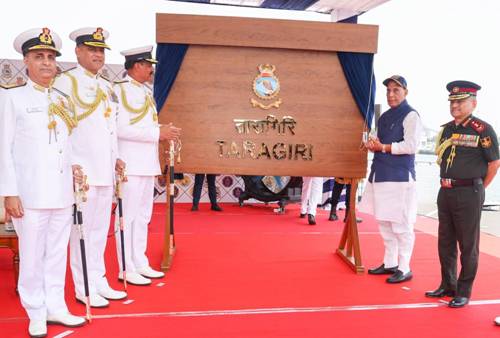
INS Taragiri displaces around 6,670 tonnes and was designed by the Indian Navy’s Warship Design Bureau. The frigate was constructed with support from more than 200 micro, small and medium enterprises, reflecting a broad domestic industrial ecosystem supporting naval programmes.
The vessel incorporates stealth design elements that reduce its radar signature and is equipped with modern sensors and weapons systems. These include advanced radar and sonar, supersonic surface‑to‑surface missiles such as BrahMos, and surface‑to‑air missile systems. Together, these systems enable the ship to undertake missions ranging from high‑intensity combat to maritime security, anti‑piracy operations, coastal surveillance and humanitarian assistance.
Defence Minister Highlights Maritime Security Priorities
Speaking at the commissioning ceremony, India’s Defence Minister Rajnath Singh described the warship as a symbol of the country’s technological progress and defence self‑reliance.
“This ship is capable of high‑speed movement and can remain deployed at sea for long durations. It is equipped with systems designed to monitor enemy activity, ensure its own protection and respond immediately when required.” — Rajnath Singh, Defence Minister, Government of India
Mr Singh noted that India’s coastline extends more than 11,000 kilometres and that the country relies heavily on maritime trade. Approximately 95% of India’s trade by volume moves through sea routes, while energy security is closely linked to maritime transport.
He emphasised that naval forces play a critical role in protecting shipping lanes, maritime chokepoints and other strategic infrastructure. In addition to conventional security responsibilities, the Indian Navy also contributes to evacuation missions, humanitarian assistance and disaster relief.
Securing Maritime Routes and Undersea Infrastructure
The defence minister also highlighted the importance of safeguarding digital infrastructure located beneath the ocean. Much of the world’s internet traffic travels through undersea fibre‑optic cables, making their protection an emerging priority in maritime security policy.
“We must not limit ourselves only to securing our coastlines; we must also ensure the protection of critical sea routes, chokepoints and digital infrastructure that are closely linked to our national interests.” — Rajnath Singh, Defence Minister, Government of India
The Indian Navy maintains a continuous operational presence across the Indian Ocean region, supporting the safe movement of commercial shipping and energy supplies. Such deployments also contribute to regional stability in the wider Indo‑Pacific.
Domestic Manufacturing and Industrial Participation
INS Taragiri contains more than 75% indigenous components, reflecting India’s ongoing efforts to strengthen domestic defence production. This approach aligns with broader initiatives aimed at expanding the country’s advanced industrial base, including developments highlighted in India advancing indigenous defence technology.
Government officials say the defence sector increasingly depends on collaboration between public shipyards, private firms and specialised manufacturers. Similar industrial strategies are also supporting growth in other sectors, such as India’s smart manufacturing in semiconductors and electronics and wider efforts to strengthen advanced and additive manufacturing capabilities.
According to the defence minister, India’s defence exports reached a record ₹38,424 crore in the financial year 2025–26, compared with around ₹1,200 crore approximately 13–14 years earlier. The government views this growth as evidence of increasing self‑reliance and expanding participation in global supply chains.
A Modern Frigate for a Changing Maritime Environment
The new frigate represents a generational improvement over earlier designs, with a streamlined structure and reduced radar cross‑section to support stealth operations. Its propulsion system combines diesel and gas engines, managed through an integrated platform management system designed to enhance operational efficiency.
Admiral Dinesh K Tripathi, Chief of the Naval Staff, noted that the ship continues the legacy of the earlier INS Taragiri commissioned in 1980, which contributed significantly to India’s anti‑submarine warfare capabilities. The latest vessel will now operate with the Eastern Fleet on India’s eastern seaboard.
As the strategic environment in the Indo‑Pacific evolves, platforms such as INS Taragiri are intended to enhance India’s ability to safeguard maritime interests, maintain credible deterrence and support cooperative security across the region.